
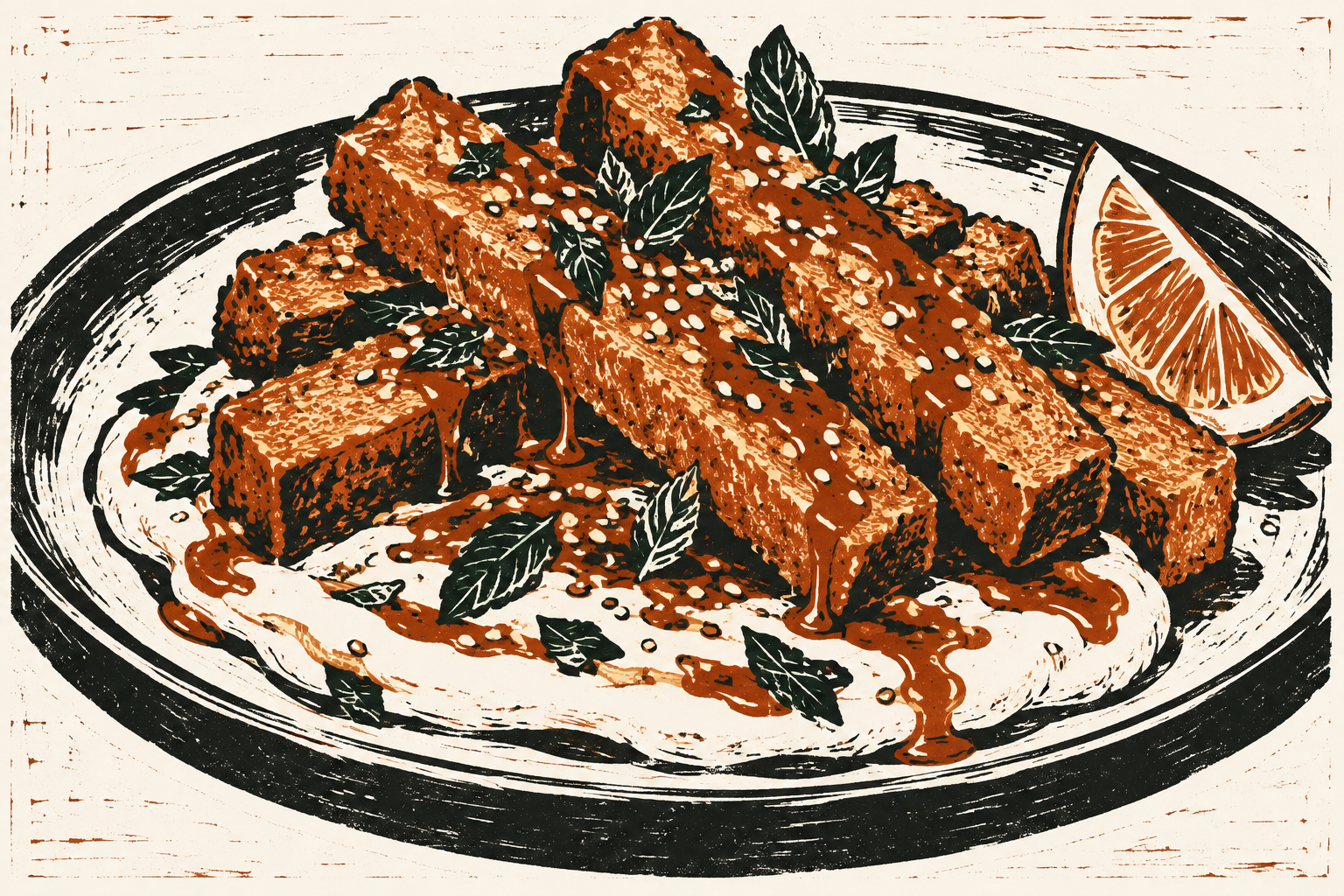
Chickpea Panisse Fries with Harissa Honey and Whipped Labneh
A shareable fried chickpea appetizer you can prep days ahead: crisp panisse batons, warm harissa honey and whipped labneh.
Not yet tested. Treat the quantities, times and temperatures as a starting point to test yourself, and follow your local food-safety rules.
Panisse is a Provençal chickpea-flour polenta that gets chilled firm, cut into batons and fried. It is one of the friendliest appetizers a small kitchen can run: the batter is cheap pantry stuff, the whole slab can be made two or three days ahead, and the à la carte work is a two-minute fry and a plate-up. Fried, the outside shatters and the inside goes soft and custardy, somewhere between a fry and a fritter.
This version leans Mediterranean-North African: warm harissa honey poured over, cold whipped labneh underneath, mint and sesame on top. Hot, cold, sweet, spicy, all in one thing people eat with their hands.
Yield: about 36 batons from a 9x13-inch pan — roughly 8 shareable appetizer portions of 4 to 5 batons, or 6 generous ones.
Ingredients
Panisse
| Ingredient | Quantity |
|---|---|
| Chickpea flour (besan / farine de pois chiche) | 2 1/2 cups (265 g) |
| Water | 5 cups (1.2 L) |
| Olive oil | 3 tbsp (45 ml), plus more for the pan |
| Kosher salt | 1 tbsp, or to taste |
| Ground cumin | 1 tsp |
| Black pepper | 1 tsp |
| Neutral oil for frying | as needed |
Harissa honey
| Ingredient | Quantity |
|---|---|
| Honey | 1/2 cup (170 g) |
| Harissa paste | 3 tbsp (45 g), adjust to your brand's heat |
| Lemon juice | 1 tbsp (15 ml) |
| Salt | a pinch |
Whipped labneh
| Ingredient | Quantity |
|---|---|
| Labneh (or very thick strained yogurt) | 2 cups (about 480 g) |
| Olive oil | 2 tbsp (30 ml) |
| Lemon zest | 1 lemon |
| Garlic, grated fine | 1 small clove |
| Salt | to taste |
To finish
- Toasted sesame seeds
- Mint leaves, torn
- Flaky salt
- Lemon wedges
Method
- Oil the pan. Brush a 9x13-inch pan generously with olive oil. If you like, line it with parchment first and oil the parchment — it makes unmolding easier.
- Whisk cold. In a heavy pot off the heat, whisk the chickpea flour into the cold water a little at a time until completely smooth. Lumps that go in cold stay lumps. Whisk in the salt, cumin and pepper.
- Cook it out. Set over medium heat and stir constantly with a whisk, switching to a stiff spatula as it thickens. It will go from loose to pudding to a stiff mass that pulls away from the sides of the pot. Expect somewhere around 12 to 18 minutes depending on your pot and burner — cook until it is thick enough to hold a spoon upright and no longer tastes raw and chalky. Stir in the 3 tbsp olive oil at the end.
- Spread and chill. Scrape into the oiled pan and spread level, about 3/4 inch (2 cm) deep. Smooth the top with an oiled offset spatula. Cool, then refrigerate until fully firm — at least a few hours, ideally overnight. Follow your local health department's rules for cooling a hot product before it goes into the walk-in.
- Cut. Turn the firm slab onto a board. Cut the 13-inch side into 3 strips of about 4 1/3 inches, then cut across into 12 batons about 3/4 inch wide: 3 x 12 = 36 batons. Keep them covered and cold until service.
- Harissa honey. Warm the honey gently with the harissa, lemon juice and salt just until pourable and combined. Do not boil it. Hold warm, or reheat in small batches to order.
- Whipped labneh. Whip the labneh with olive oil, lemon zest, garlic and salt until smooth and spoonable. Keep refrigerated.
- Fry. Fry the batons in neutral oil at around 350°F (175°C) as a starting point, in batches so the oil does not crash, until deep golden and blistered — roughly 3 to 4 minutes. Drain, season immediately with flaky salt.
- Plate. Spread a wide swoosh of cold labneh on the plate. Pile the hot batons on top, spoon over warm harissa honey, scatter sesame and mint, lemon wedge on the side.
Notes for running it on a menu
Prep ahead. The slab is the whole job. Cook and set it on a slow day; cut batons hold well covered and refrigerated for a couple of days. Cut them just before you need them so the faces stay flat and dry. Both sauces can be made ahead and held cold (the honey reheated as needed).
Par-frying. If you are slammed at service, you can fry the batons partway earlier in the day, cool them on racks, then finish them hot to order. Work out your own timing — the goal is a set, pale crust on the first pass and colour on the second.
Batching up. The recipe doubles cleanly into a half sheet pan (13x18 inches) at the same 3/4-inch depth: 5 cups chickpea flour (530 g) to 10 cups water (2.4 L). A half sheet is about twice the area of a 9x13 (234 sq in vs 117 sq in), so a doubled batch fills it to the same depth and yields roughly 68 to 72 batons — cut the 18-inch side into 4 strips and the 13-inch side into 17.
Service line. Labneh in a squeeze bottle or a cold well, honey in a warm bain, sesame and mint in third pans. Once the fryer is up, the ticket is fry, salt, plate.
Swaps. Rosemary and lemon in the batter with a plain aioli is a quieter version. A curry-leaf and black-mustard-seed tempering over yogurt takes it south Indian. Keep the slab neutral enough that one batch can serve two specials.
When you have your yields and portion sizes settled, run the dish through the menu pricing calculator to price it.
Ready to run the numbers with your own prices? Use the menu pricing calculator, or the catering pricing calculator for events.
This post was drafted with AI assistance and reviewed by a human editor before publication.